

Scented Shelf: Slow Down
On degrowth, slow perfumery, and what it means to make with intention
This edition of the Scented Shelf does not feature a book about scent specifically. Slow Down: The Degrowth Manifesto by Kohei Saito is not even really about art at all, but it has been sitting with me and I’d like to discuss, so here we are.
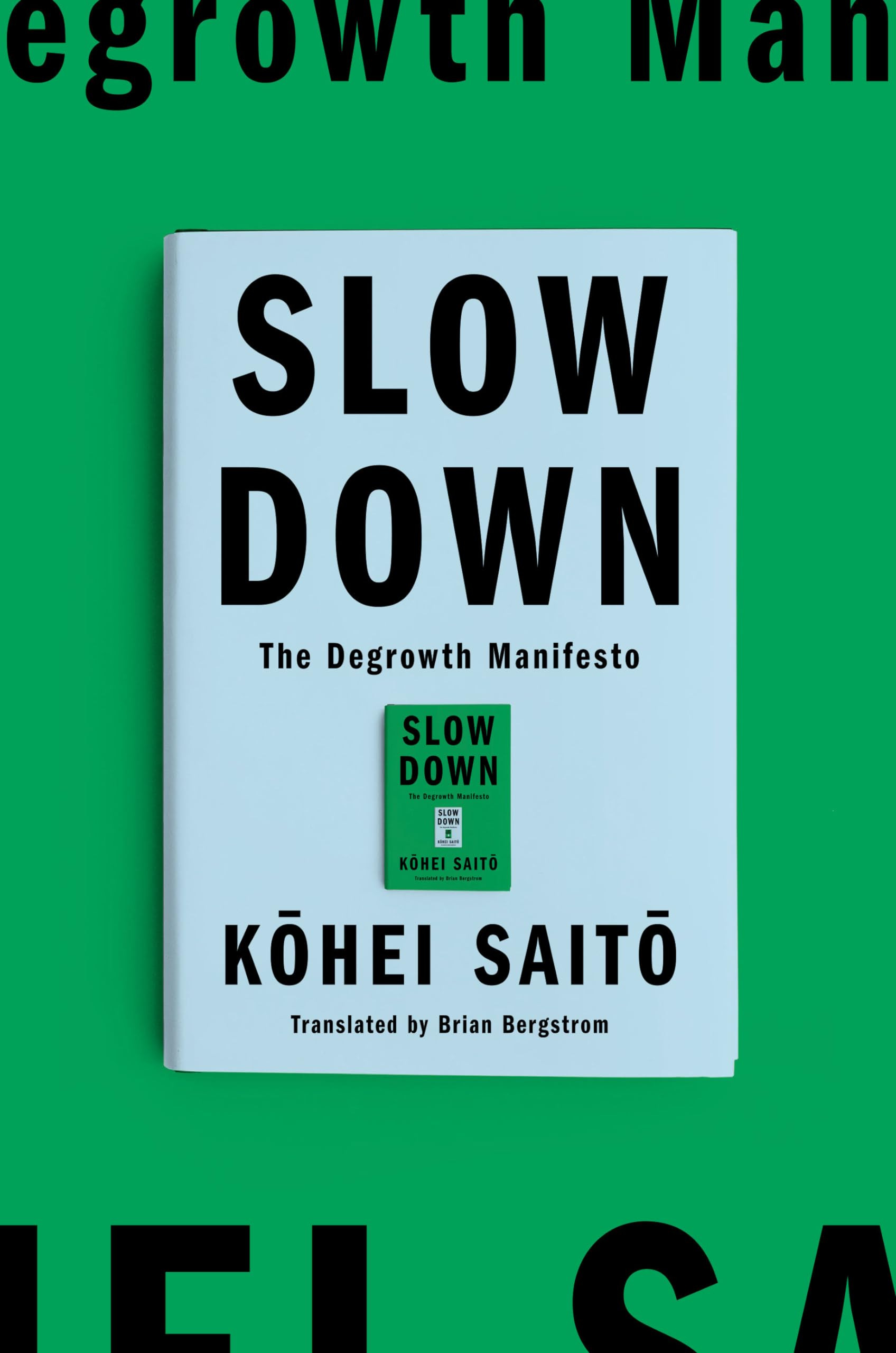
Saito’s argument is, at its core, about freedom. The degrowth framework he proposes is less a prescription for economic policy than a rethinking of what we are optimizing for. Growth, as currently structured around capitalism, demands acceleration. It demands more, faster, at scale. Saito argues that true freedom (from ecological collapse, from alienated labor, from the logic of endless accumulation) requires deliberately slowing down. He is writing from a Marxist tradition, and that framework is present throughout, but the book’s most resonant idea for me is simpler than any of its political scaffolding: that access to culture and to art is not a luxury. It is what freedom actually looks like.
I read that and immediately thought about creating, about the time to make and think and engage, and about scent.
In a recent post, I wrote about slow technology, borrowing the term from a growing movement of designers and technologists pushing back against systems built for speed and engagement over care and consideration. A few weeks ago in studio, my mentor, Michael Nordstrand, used a phrase, “slow perfumery,” that I keep thinking about. He was using it as a term to hold perfume works that tell a story, hold a narrative or concept, are considered.
Before I started learning perfumery more seriously, I understood the field through a fairly clean binary. Perfumers composed for commodities. Scent artists wove olfaction into broader artistic practices. The line seemed obvious. But the longer I work in this space the less stable that line becomes. I have encountered commodity fragrance that is genuinely artful, made with deep material knowledge and real compositional consideration. And I have encountered scent-based artwork that, somewhere in the process of scaling or producing, lost whatever made it alive. The category does not protect the work. The intention does.
This is what slow perfumery means to me, at least provisionally. Not a genre or a market position but a commitment to process. To asking why before asking how. To understanding the materials, their origins, their relationships to each other and to the people who will encounter them. To resisting the pressure to produce quickly, to scale, to optimize for reach over depth.
Saito would probably recognize this impulse. He writes about how capitalist logic colonizes not just economies but ways of thinking (what counts as productive, what counts as valuable, what counts as time well spent). To make slowly, to prioritize process over output, is in some small way a refusal of that logic. It contributes to culture differently than work made to meet a trend cycle or a production deadline. It carries a different kind of meaning.
I am still figuring out what this means for my own practice. I work across perfumery and scent art and the lines blur for me personally as much as they do conceptually. Reading Saito has made me want to be more deliberate about which pressures I am letting into studio and which ones I am keeping out. Not every project needs to move fast. Not every idea needs to become a product. Some things are worth the time they take.
The ecological dimension of this is something I keep returning to. A lot of environmental messaging places the burden on the consumer: buy less, choose better, make more conscious decisions. But the scale of extraction that threatens land, water, and air is not a consumer problem. It is a production problem. And production, in turn, is not simply a failure of individual companies but an expression of the system they operate within, a system that structurally rewards acceleration and growth over restraint and care.
I am not under the illusion that making perfume slowly dismantles that system. It doesn’t. But I do think that how we make, and why, shapes a kind of consciousness. A lived value. To work with materials attentively, to understand where they come from and what their extraction costs, to resist the pressure to scale before the work is ready, is to practice something that runs counter to the logic of accelerated production. Not as a solution, but as an orientation. A way of moving through the work that, practiced widely enough, might shift something.
Slowness is not just an aesthetic. It is a radical act.
References
Dougherty, M. “Scent Systems and Slow Technology.” Scent Made Digital, mxmdougherty.substack.com.
Nordstrand, Michael. Mythologist Studio, mythologiststudio.com.
Saito, Kohei. Slow Down: The Degrowth Manifesto. Astra House, 2024.