

Lavender Doctors
On plague doctors, miasma, and the wrong ideas that accidentally saved lives
A few years ago I was on an underground tour in Edinburgh when the guide mentioned that the plague doctor's beak was filled with herbs and flowers, that the whole point of the design was smell. I filed it away as one of those interesting historical details and have been meaning to look into it more ever since. So here's what I found.
The miasma theory held that disease rose from rotting matter, from swamps and decaying bodies and anything else that smelled like decay, and infected whoever happened to breathe it in. Miasma, loosely translated from ancient Greek, means something like stain or pollution. The idea was that bad smell was bad air was sickness, and the smell itself was the vector.
It is not a completely unreasonable thing to arrive at. Outbreaks do cluster around filth. People living in squalor did get sicker more often. The theory explained what anyone paying attention could observe. It just explained it wrong, and it traveled remarkably well. Hippocrates wrote about it in the fifth century BC, Galen expanded on it in the second century AD, medieval Islamic scholars acknowledged it, and ancient Ayurvedic texts circled around something similar. The idea showed up more or less independently across civilizations because everyone was looking at the same correlation and arriving at the same answer.
Embedded in that correlation, though, was something more than a medical hypothesis. If disease came from filth, then the people who lived closest to filth, the poor, the displaced, the crowded, were not just unlucky. They were implicated. Miasma mapped sickness onto circumstances and circumstances onto character. The smell of poverty was, quite literally, understood as dangerous.
The word malaria is one relic of all this. It comes from the Italian mala aria, “bad air,” coined around 1718 by physician Francisco Torti to describe the periodic fevers people contracted near marshy ground. The name outlasted the theory by more than a century. It is still with us now.
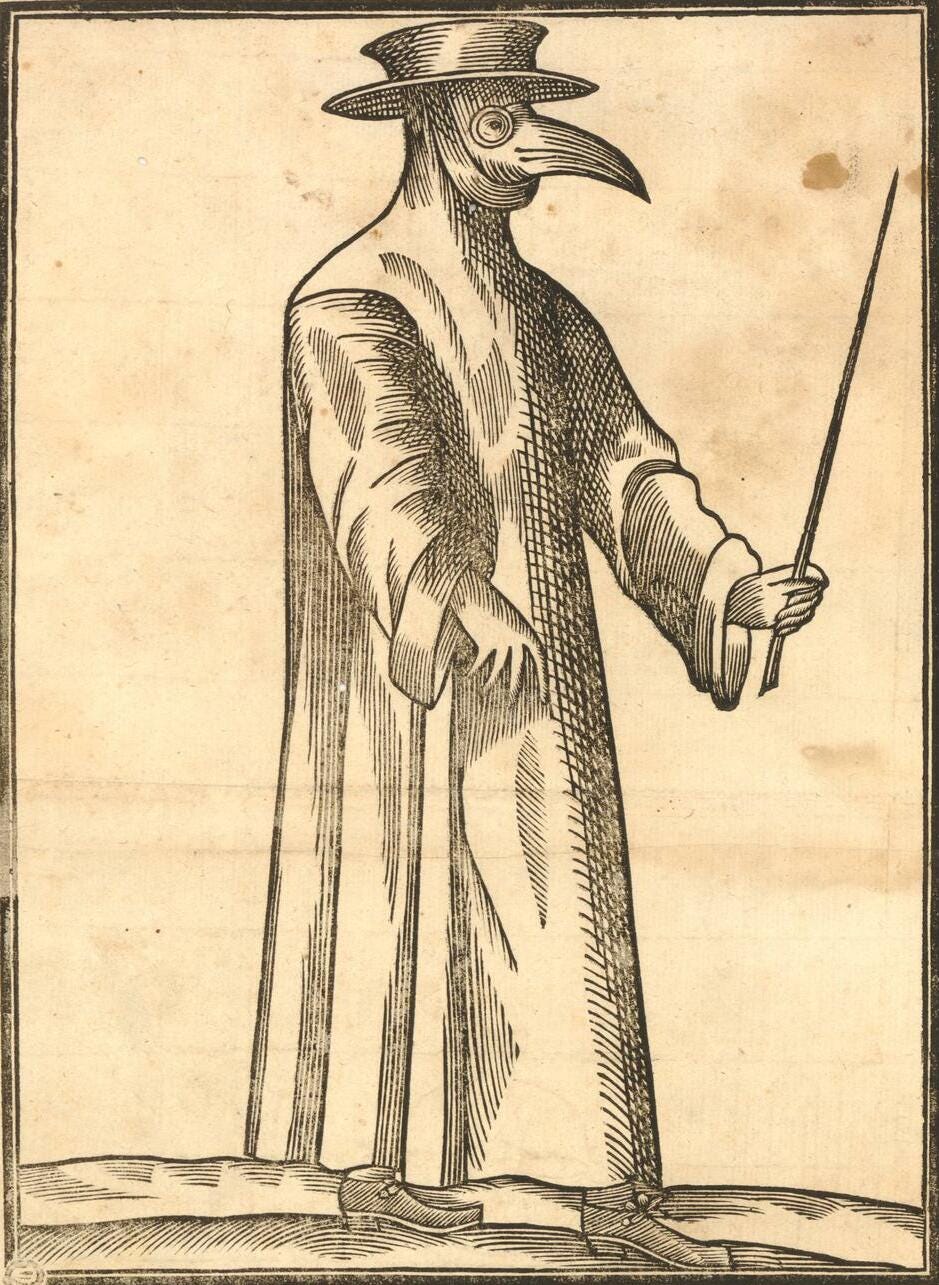
The plague doctor’s mask was miasma theory made physical. The full costume was first described in detail by Charles de Lorme, physician to King Louis XIII of France, during a 1619 outbreak in Paris. Moroccan goat leather from head to foot, a waxed linen robe, gloves, boots, a hat, and a beak about half a foot long. De Lorme wrote that the mask had a nose “shaped like a beak, filled with perfume with only two holes, one on each side near the nostrils, but that can suffice to breathe and carry along with the air one breathes the impression of the herbs enclosed further along in the beak.”
Those herbs were lavender, mint, carnations, camphor, myrrh, cloves. Some doctors used theriac, a compound of more than 55 ingredients including viper flesh powder, cinnamon, and honey. The logic was that more cavity in the beak meant more contact time between the inhaled air and the herbs inside it, treating the air before it arrived. It was a primitive filter built from the wrong premise, and it almost certainly did not protect against plague (which is actually caused by a bacteria transmitted primarily by flea bites).
But something about it did work. The leather. The waxed and sealed robe, the gloves, the boots, the full-body coverage made it genuinely difficult for fleas to reach skin, and the mask itself created a physical barrier against droplets in cases of pneumonic plague. The doctors were protected, and the reason had nothing to do with their understanding of why. They were constructing personal protective equipment from a wrong theory, but the equipment did work anyway.
The same pattern played out at a much larger scale in Victorian London. By the mid-19th century, the city’s population had exploded and its infrastructure had not kept up. The Thames had effectively become an open sewer, and in the summer of 1858, an intense heat baked the river’s contents until the smell became physically unbearable, forcing Parliament to close. This was called the Great Stink.
The authorities, committed miasmatists, were alarmed. Sanitary reformer Edwin Chadwick had declared to Parliament that all smell was disease, and if that was true, London was in serious trouble. They commissioned engineer Joseph Bazalgette to build a comprehensive sewer network, which redirected sewage away from the Thames and away from the city’s drinking water. The cholera outbreaks that had killed tens of thousands of Londoners over the previous decades stopped. They built it to fight smells and it fought waterborne illness instead.
Physician John Snow had been trying to tell them the actual reason since 1849. His investigation of an 1854 cholera outbreak in Soho traced every death to users of a contaminated pump on Broad Street. He mapped the cases, removed the pump handle, and the outbreak subsided. His paper was largely ignored. He died in 1858, the same summer as the Great Stink, without seeing his theory accepted. Florence Nightingale, also a miasmatist, overhauled sanitation in Crimean War hospitals and dramatically cut the mortality rate for much the same accidental reason. She was right that the conditions needed to change, but was just wrong about why.
Germ theory arrived in the 1860s and 70s, when Louis Pasteur and Robert Koch demonstrated that specific microorganisms caused specific diseases. The beak masks disappeared. Nosegays of lavender stopped being medicine. The science moved on.
The social logic was slower to follow. Miasma had given people a way to think about filth as a moral category, and that framework did not dissolve when the medical theory was replaced. The association between smell, poverty, and danger proved more durable than the theory that had produced it. Disease continued to be mapped onto marginalized communities, immigrant populations, and the poor, now dressed in the language of contagion rather than bad air, but drawing on the same underlying logic. The metaphors miasma generated outlasted miasma itself.
What I find genuinely interesting about the plague doctor’s mask is that it holds all of this at once. It is a serious attempt at protection, a perfume delivery system worn out of real care, a piece of equipment that worked for reasons its designers did not understand, and an artifact of a way of thinking about bodies, smell, and belonging that has never fully gone away. Bazalgette’s sewers are still under London. Malaria is still called malaria. And the instinct to locate danger in the smell of other people’s lives is, unfortunately, still recognizable.
References
Britannica, The Editors of Encyclopaedia. “Plague Doctor.” Encyclopaedia Britannica, 2026.
Harper, Douglas. “Etymology of Malaria.” Online Etymology Dictionary, accessed April 2026.
Kiechle, Melanie A. “Miasma Theory: A Primer.” Nursing Clio, June 2025.
London Museum. “John Snow, Cholera & the Broad Street Pump.”
Pelling, Margaret. “Death and Miasma in Victorian London: An Obstinate Belief.” BMJ, 2001.
Science Museum. “Cholera in Victorian London.”
Shah, Svati Kirsten. “From Miasma to Ebola: The History of Racist Moral Panic Over Disease.” Jezebel, 2014.